
Description
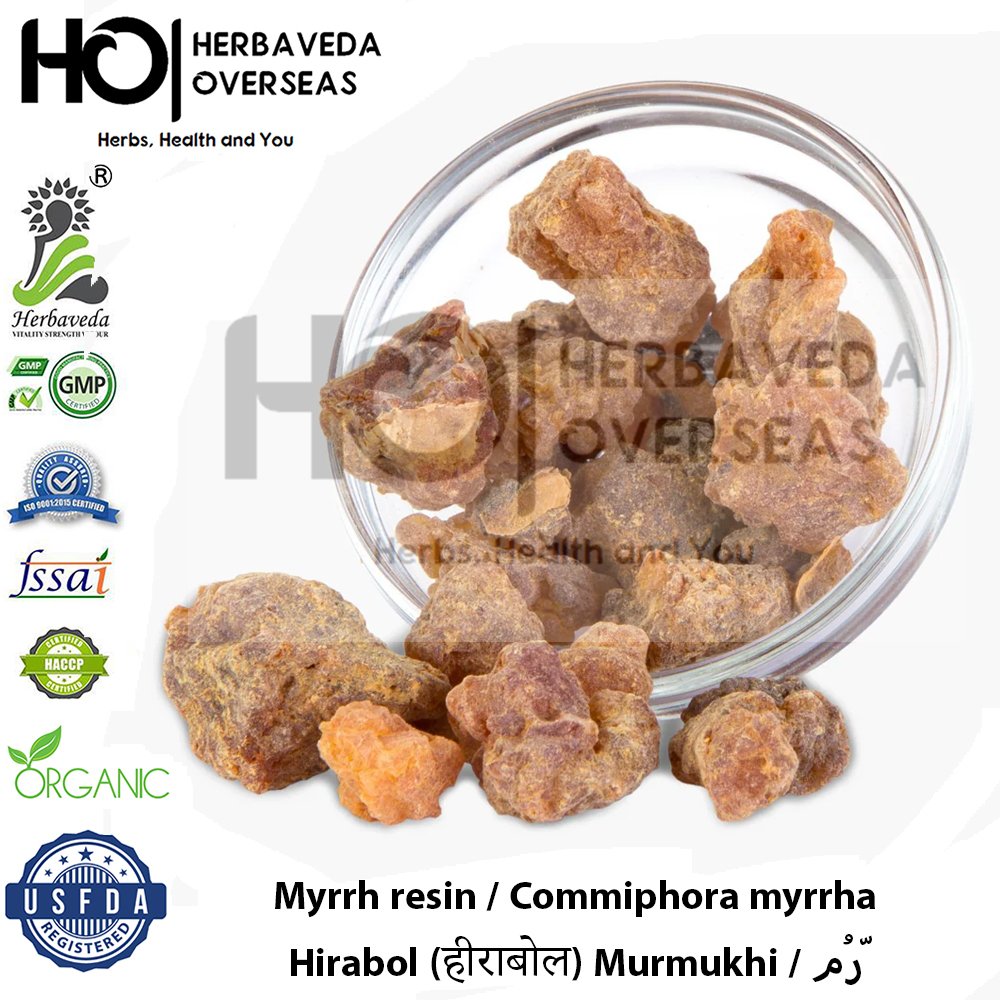
Commiphora myrrha, the myrrh tree, is a small, thorny deciduous tree of the family Burseraceae, native to the dry coastal and escarpment scrublands of northeastern Africa — principally Somalia, Ethiopia, Eritrea, and Djibouti — and the southern Arabian Peninsula. Myrrh resin is obtained by tapping the bark, which exudes a pale yellowish-white liquid that hardens on contact with air into characteristic dark brown to orange-red irregularly shaped lumps with a distinctive balsamic, slightly bitter fragrance. Among the most ancient internationally traded botanical commodities, myrrh appears in the Ebers Papyrus, the Book of Exodus, ancient Chinese medical texts, and Ayurvedic references as Hirabol. Incorporated in Unani formulations under the name Murr, it has been traditionally used in preparations for wound care, dental hygiene, reproductive health, and anti-inflammatory applications.